Current Source Circuit

Current source circuit
To produce current, according to Ohm's law I = V/R, we need only voltage and resistance. So, if the load was pure resistive, we would need only a voltage source to produce current. By changing the voltage, we can set the desired current magnitude.
What is considered a current source?
A current source is an electronic circuit that delivers or absorbs an electric current which is independent of the voltage across it. A current source is the dual of a voltage source. The term current sink is sometimes used for sources fed from a negative voltage supply.
What is voltage and current source?
A voltage source is a two-terminal device which can maintain a fixed voltage. An ideal voltage source can maintain the fixed voltage independent of the load resistance or the output current. However, a real-world voltage source cannot supply unlimited current. A voltage source is the dual of a current source.
Does current source have voltage?
A current source can certainly have a voltage across it. If the voltage across a current source is zero, then it is not delivering or absorbing any power. However, if the voltage across the source is not zero, then it is either sourcing or sinking power into the rest of the circuit.
Do current sources absorb power?
Depending on the actual polarity of the voltage across the source, the current source can either provide or absorb power. The circuit notation for an ideal current source is given in Figure 1.19.
What is current source function?
A current source establishes a specified amount of electric current in a portion of a circuit. The value of the current source is the magnitude of current flow created by the source, and the symbol includes an arrow to indicate the direction of the current.
Is battery a current source?
A battery is a voltage source, not a current source. Some terminology: what you attach across a source is often referred to as a ``load''. Ideal sources are independent of load.
Why transistor is a current source?
The current source operates because of the fact that the collector current in a transistor circuit is Β times the base current. This is independent of the collector voltage, provided that there is sufficient voltage to drive the current through the load device in the collector.
What is difference between current and voltage?
In other words, voltage is the difference in electric potential between two points. Current is just the rate of flow of electric charge. In simple words, the current is the rate at which electric charge flows in a circuit at a particular point. The SI unit of voltage is Volts (V).
What is source in circuit?
An electrical supply or simply, “a source”, is a device that supplies electrical power to a circuit in the form of a voltage source or a current source.
Can you add current sources in parallel?
Current sources of different values may be connected together in parallel. For example, one of 5 amps and one of 3 amps would combined to give a single current source of 8 amperes as the arrows representing the current source both point in the same direction.
How do you find the power of a current source?
The power output of a current source = V*I where V is the voltage across the source with the + sign on the current out side. Current sources with V*I < 0 are consuming power. The power output of a voltage source = V*I where I is the current out of the + side of the voltage source.
Can two current sources be connected in series?
If two current sources are connected in series, then the source rated for lower current will act upon the circuit. The other source will become redundant. Case 2: If the two voltage sources are connected in parallel, then the source rated for higher voltage will act upon the circuit.
What happens when a current source is shorted?
A short circuit is when there is a low resistance connection between two conductors supplying electrical power to a circuit. This would generate an excess of voltage streaming and cause an excessive current flow in the power source.
How do you know if a current source is absorbing or delivering power?
If the element is active then it is supplying power, and if the element is passive then it is absorbing power, and the convention covers both cases. Positive current entering the most positive voltage node means the element is passive, positive current leaving the most positive voltage node means the element is active.
Do resistors absorb current?
In words, a resistor can absorb power from a circuit (by converting electrical energy into heat energy), but can never deliver power.
Do current sources supply power?
A power supply is a device that supplies electrical energy to a load, and there are two types: voltage sources and current sources. In general, power supply" often means a voltage source, but there are also current sources that supply current.
Do batteries supply ac or DC?
Batteries and electronic devices like TVs, computers and DVD players use DC electricity - once an AC current enters a device, it's converted to DC. A typical battery supplies around 1.5 volts of DC.
What is the main source of ac?
An ac is produced by an alternating emf, which is generated in a power plant, as described in Induced Electric Fields. If the ac source varies periodically, particularly sinusoidally, the circuit is known as an ac circuit. Examples include the commercial and residential power that serves so many of our needs.
Is BJT a current source?
BJT is a current controlled device because the output characteristics of BJT are determined by the input current. In a p-n junction i.e base-emitter junction in BJT the change in voltage (Vbe) is produced only after the change in base current. BJT is called voltage called current source and not otherwise.
12 Current source circuit Images
Electrical Engineering Circuit Analysis Mesh Analysis w Voltage

Few LM317 Voltage regulator circuits that has a lot of applications

Design LM317 Constant Current Source Circuits

Current Source vs Voltage Source Current Source Voltage Source

Efficient Power Supply and Voltage Regulator Analysis

24 Electrical

Basics of Phototransistor Circuit board design Circuit Electronics

Design a Voltage Controlled Current Source Circuit using OpAmp

Although wellknown to activefilter theorists and designers GICs
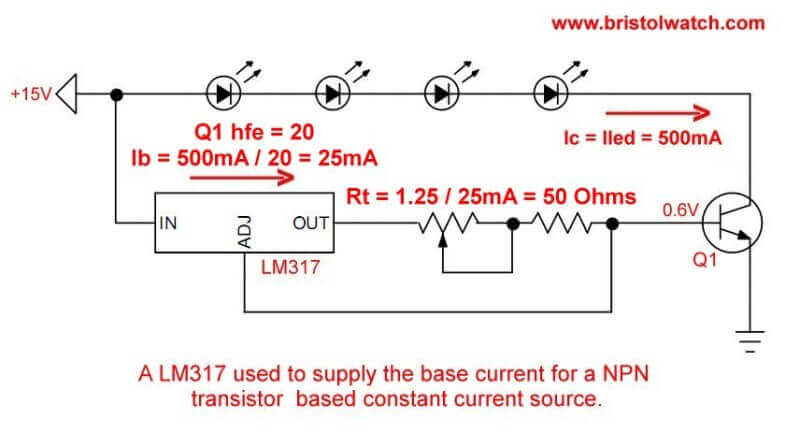
Constant current source with NPN transistor Constant current

VoltageControlled Current Sink using OpAmp Circuit Diagram Circuit

Post a Comment for "Current Source Circuit"