Kirchhoff's Voltage Law Equation

Kirchhoff's voltage law equation
The total current entering a junction or a node is equal to the charge leaving the node as no charge is lost. Put differently, the algebraic sum of every current entering and leaving the node has to be null. This property of Kirchhoff law is commonly called Conservation of charge wherein, I(exit) + I(enter) = 0.
What is the formula of KVL and KCL?
In other words, Vin = VR1 + VR2. Additionally, the voltage across R2 and R3 is equal because these resistors are connected in parallel: VR2 = VR3. According to Kirchoff's Current Law (KCL), the sum of all currents entering a node equals to the sum of all currents leaving it.
What is Kirchhoff's 1st and 2nd law?
Kirchhoff's first law is based on the conservation of charge because sum of current entering to the junction is equal to sum of current leaving the junction. Kirchhoff's second law states that the algebraic sum of potential drops in a closed circuit is zero. So, it is based on the conservation of energy.
Why is Kirchhoff's voltage law true?
KVL is true because voltage rises and drops are defined to be gains and losses, respectively, in electric potential energy of a +1\text{ C} charge. Since a loop starts and ends at the same place, the gains and losses around the loop must balance according to the conservation of energy.
What is Kirchhoff's first law?
Kirchhoff's first law applies to currents at a junction in a circuit. It states that at a junction in an electrical circuit, the sum of currents flowing into the junction is equal to the sum of currents flowing out of the junction.
How do you solve Kvl?
More videos on YouTube
- Take your time, breathe, and assess the problem.
- Assign mesh currents to all of the meshes. ...
- Apply KVL to each of the meshes, using Ohm's Law to show the voltages in terms of the current.
- Solve the simultaneous equations (like we did with KCL) to find the actual values.
- Sanity check.
What does Kvl stand for?
What is Kirchhoff's Voltage Law (KVL)? The principle known as Kirchhoff's Voltage Law (discovered in 1847 by Gustav R. Kirchhoff, a German physicist) can be stated as such: “The algebraic sum of all voltages in a loop must equal zero”
What are Kirchhoff's Three laws?
Whenever you are studying the light from an astronomical object, recall that there are three things you need to consider: the emission of the light by the source, processes that affect the light during its travel from the source to the observer, and. the process of detection of the light by the observer.
What are Kirchhoff's two rules?
Kirchhoff's first rule—the junction rule. The sum of all currents entering a junction must equal the sum of all currents leaving the junction. Kirchhoff's second rule—the loop rule. The algebraic sum of changes in potential around any closed circuit path (loop) must be zero.
Why is Kirchhoff's law used?
Kirchhoff's laws are used to help us understand how current and voltage work within a circuit. They can also be used to analyze complex circuits that can't be reduced to one equivalent resistance using what you already know about series and parallel resistors.
How do I calculate voltage?
When spelled out, it means voltage = current x resistance, or volts = amps x ohms, or V = A x Ω.
What is another name for KCL & Kvl?
These two rules are commonly known as: Kirchhoffs Circuit Laws with one of Kirchhoffs laws dealing with the current flowing around a closed circuit, Kirchhoffs Current Law, (KCL) while the other law deals with the voltage sources present in a closed circuit, Kirchhoffs Voltage Law, (KVL).
What is Kirchhoff's junction law?
Kirchhoff's junction rule says that the total current into a junction equals the total current out of the junction. This is a statement of conservation of charge.
What does Kirchhoff's current law state?
Kirchhoff's Current Law, often shortened to KCL, states that “The algebraic sum of all currents entering and exiting a node must equal zero.” This law is used to describe how a charge enters and leaves a wire junction point or node on a wire.
How many equations are in Kvl?
This circuit has 4 junctions, 5 loops, and 6 branches. Thus there should be 3 independent KVL equations.
Where is direction in Kvl?
So across the 3 ohm resistor i1 is flowing in that direction. So this is going to be positive. And
Where do we use KVL and KCL?
Whichever gives an easy set of equations. If you are doing resistor networks, count if there are more loops or more nodes. KVL if there are more loops, KCL if there are more nodes. In more advanced circuits, like transistors, there is normally a very specific mode that lends itself to your problem space.
How do you prove Kirchhoff's law?
So, for Kirchhoff's junction rule to hold true, the sum of the currents into point F must equal the sum of the currents flowing out of the junction at node E. As the two currents entering junction E are 3 amps and 2 amps respectively, the sum of the currents entering point F is therefore: 3 + 2 = 5 amperes.
Can we apply KVL in open circuit?
Answer. Answer: If you look at an open circuit as a circuit with an infinite resistance, you can apply KVL without ambiguity.
How do you use Kirchhoff's loop rule?
We refer to this as Kirchhoff's Loop Rule. We measure the differences in voltage in Volts (V). When you have the current I in the loop given Amperes (A) and resistance of circuit elements in Ohms (Ω), then we can find the voltage difference across a resistor by using the formula V = IR.
14 Kirchhoff's voltage law equation Images
Kirchhoffs Laws define how current and voltage are distributed in
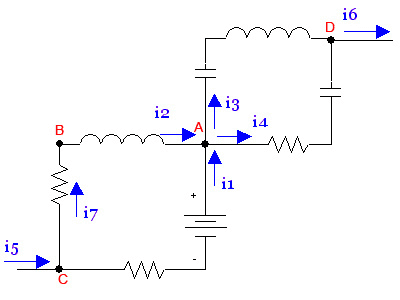
Kirchhoff Current Law Node diagam Math Electrical engineering Chart

Kirchhoffs Current and Voltage Law KCL and KVL with Xcos example

Kirchhoffs Voltage Law KVL Divider Circuits And Kirchhoffs Laws

Kirchhoffs Laws For Electrical Engineers Beginners EEP

A Brief on Kirchhoffs Laws with Circuit Diagram Electronic

Kirchhoffs Voltage Law KVL Divider Circuits And Kirchhoffs Laws

Kirchhoffs Voltage Law KVL Circuits Loop Rule Ohms Law Series

Important Questions for CBSE Class 12 Physics Kirchhoffs Laws and

kirchhoffsvoltagelawcurrentlaw Thevinins theorem with current

Kirchhoffs Voltage Law KVL Divider Circuits And Kirchhoffs Laws

Kirchhoffs Voltage Law KVL Circuits Loop Rule Ohms Law Series

Kirchhoffs Voltage Law

Post a Comment for "Kirchhoff's Voltage Law Equation"