Wire An Outlet

Wire an outlet
Wire the New Electrical Outlet
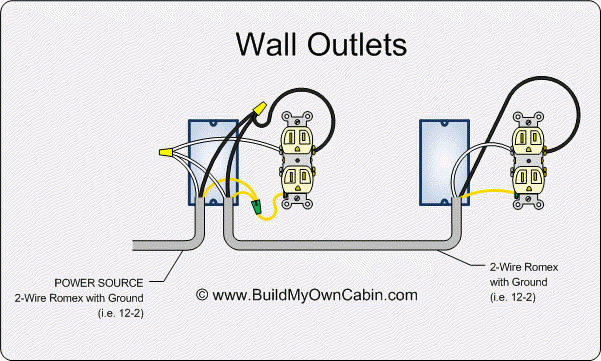
<ol class="X5LH0c"><li class="TrT0Xe">Mount the new box in the opening.</li><li class="TrT0Xe">Connect the new wires to the new outlet: white (neutral) wire to a silver-colored terminal screw; black (hot) wire to a gold-colored terminal screw; bare wire to the green grounding screw.</li><li class="TrT0Xe">Make sure the cable sheath remains secured inside the box.</li></ol>Does it matter which wire goes where on an outlet?
As long as they are on the proper terminal, it doesn't matter. The silver terminal is the neutral. The yellow or brass colored terminal is for the hot wire. The green terminal is for ground.
Can you wire an outlet wrong?
But here's the catch: If you connect the circuit wires to the wrong terminals on an outlet, the outlet will still work, but the polarity will be backward. When this happens, a lamp, for example, will have its bulb socket sleeve energized rather than the little tab inside the socket.
Why do electricians put outlets upside down?
Electricians may position the outlet in an upside-down position so that you can quickly identify the switch-controlled receptacle. Since it stands out visually to most people right away – it provides convenience to the occupants to easily remember which outlet is switch controlled.
What happens if you wire a outlet backwards?
Reverse polarity outlets will still provide electricity to lamps, appliances, and other items. Saltzman says electrical equipment will continue to function and won't be damaged by the incorrect wiring. However, you might be more susceptible to a shock.
What color wire goes on outlet?
A simple standard electrical circuit has a black or red "hot" wire that carries power from the power source to the device (e.g., switch, fixture, outlet, appliance), a white neutral wire that carries the power back to the power source, and a green or bare copper ground wire that connects the device to the home's
Why would an outlet have 2 hot wires?
The reason for multiple hot/neutral wires for one outlet is that the outlets are daisy-chained together. This means hot/neutral is only coming from one of the wires and it is being sent to the other wire.
What happens if the live and neutral wires are swapped?
There would be a shock hazard, and some devices might not work correctly. Depending on where exactly the wires are flipped, ground fault detecting circuit breakers may become ineffective. All around, this is a bad idea.
Can Reverse polarity cause a fire?
Watch out: Reversed polarity on an electrical outlet is dangerous. If you accidentally reverse these wires the device you plug in to the receptacle may "work" but it is unsafe and risks a short circuit, shock, or fire.
How do you check if an outlet is wired correctly?
Make sure you get good contact with your probes inside the plug a third way to tell is to use a hot
Does it matter if live and neutral are reversed?
As per the rules, if live and neutral are reversed, Electricity board will not give power to your house. Please correct it immediately for your and service person safety.
Should outlets be ground up or down?
The National Electrical Code (NEC) doesn't require a certain direction. The NEC allows outlets to be installed with the ground plug hole facing up, down or sideways. It's up to you, there is no standard electric outlet orientation. So that means there really is no such thing as upside down outlets.
Is it code to install outlets upside down?
In reality, there is no code requirement that says an outlet receptacle should be installed one way or the other. In fact, at one time some manufacturers actually recommended the orientation that many of us view as upside down—with the round grounding slot at the top.
What is the electrical code for outlets?
The US National Electrical Code, Section 210.52, states that there should be an electrical outlet in every kitchen, bedroom, living room, family room, and any other room that has dedicated living space. They must be positioned at least every twelve feet measured along the floor line.
Can wiring a light switch wrong cause a fire?
Wiring a smart light switch wrong can result in the switch not working correctly. If the wiring creates a short circuit, it can lead to damage to the switch and/or a burnt-out fuse. Errors can also lead to electric shock, fire, and a violation of local wiring codes.
What happens if you wire white to black?
Most of the time, you might accidentally connect a white wire to a black wire during the wiring process. However, the result will not be good when you turn ON the power. Here, the sparks will occur at the circuit breaker or the fuse instead of in the wires. Also, it might trip the breaker or blow the fuse.
Which side of outlet is black wire?
White (neutral) goes on the side allocated for the larger prong. Black (Hot) goes on the smaller prong side or white to silver screws, black to gold screws. Ground (bare wire) to green.
Which color wires go together?
The protective ground is green or green with yellow stripe. The neutral is white, the hot (live or active) single phase wires are black , and red in the case of a second active.
Does hot wire go on top or bottom of outlet?
The black 6" wire will terminate on one of the brass-colored screws, the red one on the other brass screw, and the white one on the silver-colored screw. It is most common to put the red wire on the bottom screw, since that will make the top plug-in "hot" at all times and will be a little easier to plug things into it.
Can red and black wires go together?
Can I Connect Red And Black Wires Together? Yes, it is sometimes feasible to connect a red and black wire together for a variety of reasons such as connecting smoke detectors, wiring back to a switch, a 3-way switch circuit, and other reasons.
14 Wire an outlet Images
How to Wire a Switched Outlet YouTube Home Maintenance Power Strip

an electrical box with the words how to wire a 50 amp outlet

Video How to Wire a HalfSwitched Outlet Electrical outlets Wire

Wiring Diagrams for Multiple Receptacle Outlets Home electrical

How to wire outlet switch and Light Electricity Pinterest
Electrical wiring diagram Electrical wiring and Dining rooms on Pinterest

Image result for ground wire color Home electrical wiring Electrical

wiring 240v plug Google Search Dryer plug Outlet wiring

wiring diagram for two 120 volt gfci outlets in a circuit Home

How to install a 220 Volt 4 wire outlet AskmeDIY Installation

Instructions Switched Outlet Electrical Wiring Diagram 1 httpwww

Wiring Diagram for GFCI Outlet and Light Switch

How to Wire a 240V AC Outlet Trip Wire Alarm Survival Skills Howto

Post a Comment for "Wire An Outlet"